
In August, equity markets rebounded as concerns around AI-related stocks eased, with positive returns across most regions. Sovereign bond returns were more mixed, as investors considered government borrowing, inflation expectations and the outlook for interest rates.
Equities continue their positive year
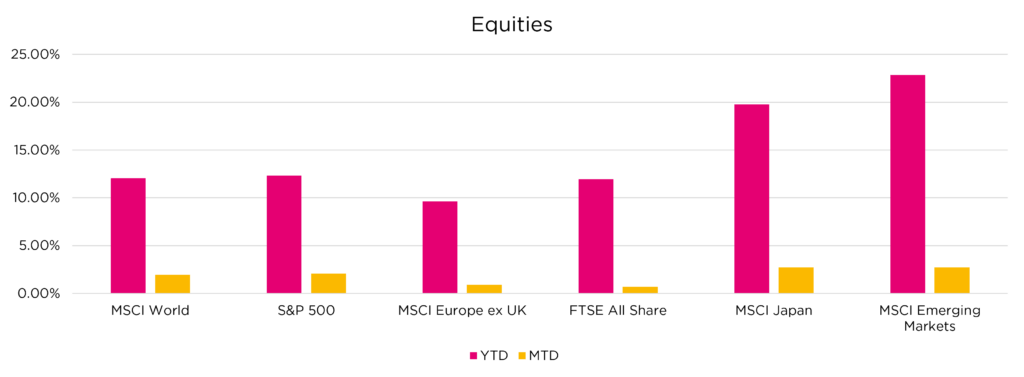
A strong month for equities across most regions extended the positive returns seen so far this year. The MSCI World Index, a measure of global equities, returned 1.9% over the month, taking its return for the year to 12.1%. US equities made a significant contribution, reflecting their large weight in the index.
During the month, investors became more comfortable with earlier concerns around AI-related companies. Nvidia reported quarterly revenue of $96bn, up 106% on the previous year. The wider technology rebound was also supported by software companies. After a difficult 12 months, several companies reported earnings that were stronger than markets had expected, improving confidence in the sector.
UK equities delivered positive, though more modest, returns than in July. This partly reflected investors moving back towards technology companies, which have lower representation in the UK market. The UK market has, however, provided useful diversification at times of heightened concern around the conflict involving Iran.
Emerging markets remain closely linked to confidence in the AI investment theme, given their role in supplying memory chips and other key components. Returns of 22.9% so far in 2026 underline this connection. July’s weaker performance, driven largely by broader concerns around AI, reversed in August as stocks recovered. Announcements of share buybacks and dividends from two key stocks: SK Hynix and Samsung Electronics, were welcomed by investors, and the region returned 2.7%.
Past performance is not necessarily a guide to future performance and is not guaranteed. Performance comparisons are included for illustration purposes only, there are no specific benchmarks.
Figure 1: Equity Market Returns (Source: Bloomberg, August 2026.)
Long-term government bonds remain in focus
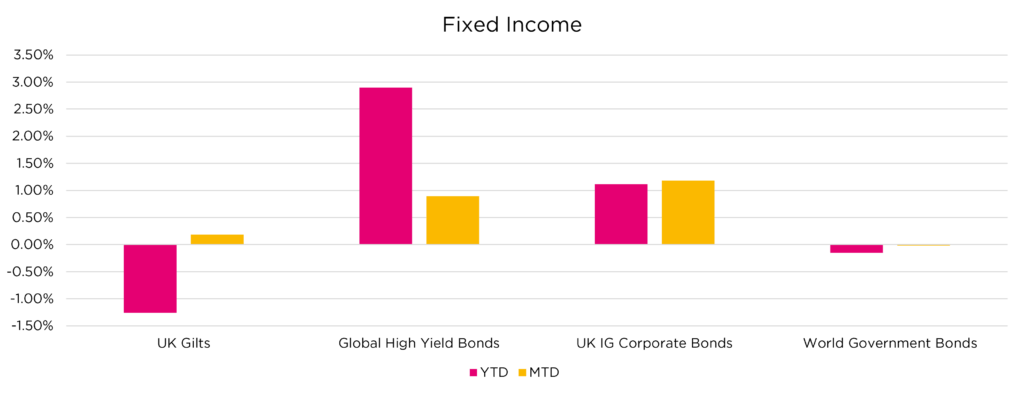
Global government bonds were broadly flat, while UK government bonds delivered modestly positive returns, despite some challenging headlines. In the US, national debt exceeded $40tn, or around $117,000 per person.
At the same time, the yield on 30-year US government bonds increased to its highest level since 2007, as investors sought higher compensation for lending to the US government.
There is rarely one explanation for moves in bond markets. Continued conflict in Iran, higher inflation expectations and ongoing government spending may all have contributed. US Treasury Secretary Scott Bessent announced action to combat this rise in bond yields, which he stated was intended to support market functioning. The immediate market impact was limited, but the move indicated policymakers’ awareness of the higher level of long-term borrowing costs.
In the UK, inflation rose slightly from July to 2.9%, driven in part by energy prices. Gas prices reached levels last seen in 2022, around the start of Russia’s invasion of Ukraine. Oil prices remained stable at around $90 a barrel during the month, reflecting continued geopolitical tension in the Middle East.
Gold regains some sparkle
The gold price rose over the month, with gold gaining 12% and gold mining stocks up 37.2%. This strong return was in part due to Secretary Bessent’s actions, as government intervention in bond yields led investors to favour ‘hard assets’, which have a finite supply, such as gold. This, coupled with continued concerns about government debt, have made Gold a useful diversifier over the past two years.
Past performance is not necessarily a guide to future performance and is not guaranteed. Performance comparisons are included for illustration purposes only, there are no specific benchmarks.
Figure 2: Fixed income returns (Source: Bloomberg, August 2026)
Summary
Overall, August was more positive for markets than July. Shares recovered, supported by renewed confidence in technology companies and businesses connected to AI investment. Government bond markets were more subdued, as investors continued to weigh higher debt levels, inflation and the outlook for interest rates. This was reflected in higher yields on longer-dated bonds. However, this led to a rally in other securities, such as gold.