

- Markets remain remarkably resilient, with equities near all-time highs despite the unresolved Iran conflict, higher energy prices and firmer inflation.
- AI capital spending is the main growth engine, offsetting a softer consumer and supporting GDP, semiconductor demand and corporate earnings.
- Inflation has re-accelerated enough to push central banks back towards hiking, while reduced Fed forward guidance could increase market volatility.
- The preferred positioning is still equities, especially emerging markets and selective value, though the AI trade and some regional exposures look increasingly crowded.
OUTLOOK
Headlines have spent the past three months lurching between hope and alarm, yet equities are once again close to all-time highs. Despite the lack of a resolution to the conflict with Iran and elevated energy prices, markets have been remarkably resilient. Global growth remains reasonable, with a slightly weaker global consumer being more than offset by the AI capital spending that continues to generate positive surprises in terms of both earnings and growth.
Headline inflation in the US, UK and euro area has picked up since the beginning of the conflict, with the US print running just above 3%, up from 2.5% before the conflict and comfortably above the target of 2%. The ECB and the Fed have already hiked, and the Bank of England is almost certain to do so before the end of the year. Our tracker of 40 major central banks shows the synchronised cutting cycle of 2024/25 has swung into the hiking zone and the key question now is whether this inflation proves temporary or marks the start of second-round effects. Adding to the uncertainty, new Fed Chair Kevin Warsh has signalled a very different communication style to his predecessors, with less “forward guidance”. Expect more volatility around Fed communication from here.
The Scale of the AI Capex Cycle
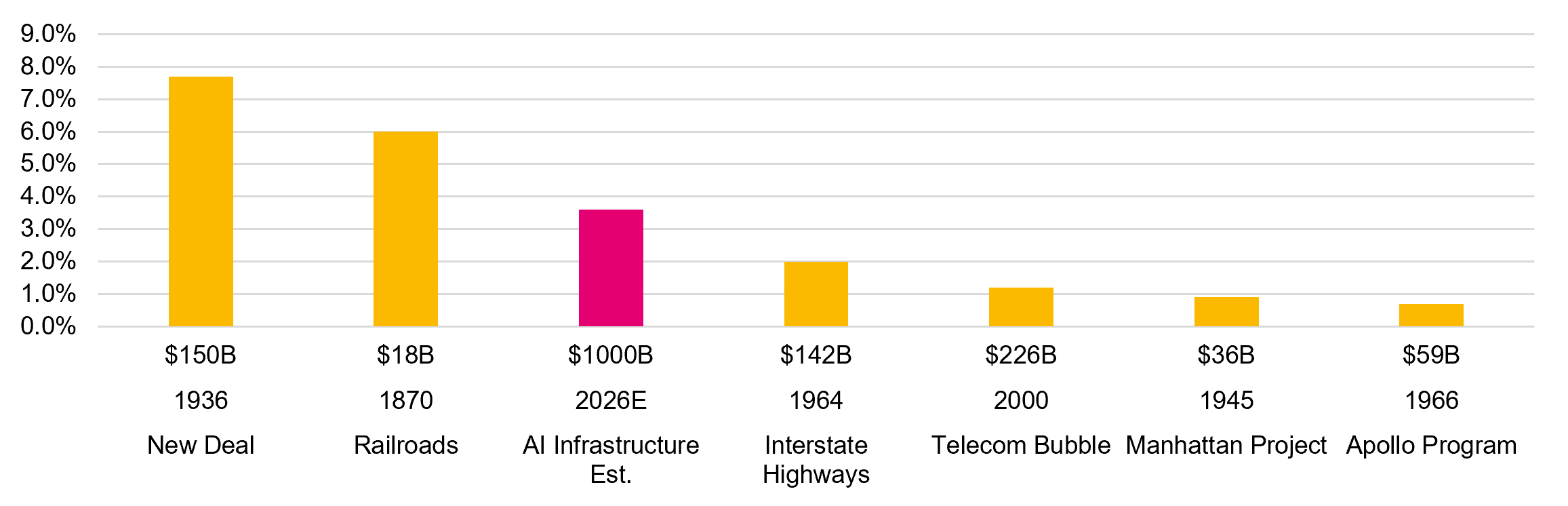
Despite all this, growth has proved resilient, and the reason is not the consumer, whose confidence remains soft, but capital spending. Direct AI build-out, its downstream effects, and supportive fiscal policy have all helped growth this year. Hyperscaler capex is now reshaping the US economy in its own right: the contribution of software and information-processing investment to GDP has tripled from its 2016-2024 average of around 0.25 percentage points to roughly 0.75 today. Should AI infrastructure investment reach the $1 trillion some forecast for 2027, it would represent about 3.5% of US GDP – larger, relative to the economy, than the railroad expansion of the 1890s and the dot-com boom of the early 2000s. The downstream effects are most visible in semiconductor demand, which has roughly doubled over the past year to over $100 billion a quarter, but the impact has been felt across corporate earnings, which are on a tear. It is this earnings backdrop that continues to support equity valuations that otherwise look stretched.
The scale of AI Capex (percentage of GDP)
The Stealth Bull Market in Value, Revisited
One of the ways that we have allocated to these stocks is through our sector-neutral “Value 2.0” ETF positions, which hold the cheapest stocks within each sector at market weight rather than piling into cheap sectors outright. At the start of the year, the technology names in our value allocation traded on an average forward multiple of 25 times earnings against 62 times for the cap-weighted technology index; Micron alone traded on 8 times earnings versus Nvidia’s 25. By the end of June, the value basket’s technology names had returned an average of 163%, led by Micron’s 305%, comfortably beating the index’s 10%. Remarkably, the basket has become cheaper over that period, as earnings estimates have grown even faster than share prices – Micron’s own earnings are up over twelve-fold since the AI cycle began, close to the opposite of the dot-com era, when weak earnings met extraordinary multiples. That said, we trimmed our US and emerging market value exposure in the second quarter: strong performance has bred crowding, particularly around Korean semiconductor names, where leveraged ETF flows and rich American depositary receipts (ADR) premiums point to some exuberance, even as we retain conviction in the broader opportunity.
Three IPOs for the History Books
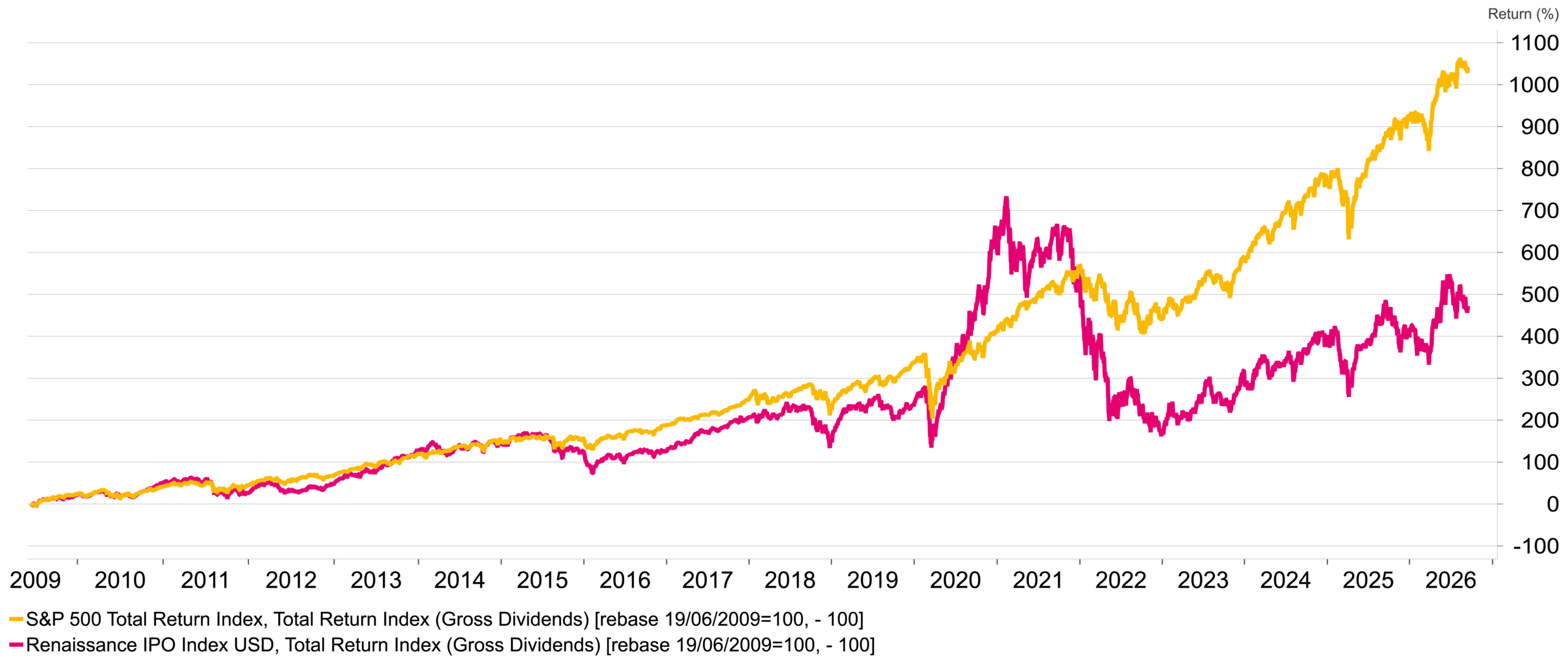
This piece would not be complete without mention of SpaceX, whose $86 billion listing was the largest IPO in history, roughly three times the size of the previous record and at an overall valuation of c.$1.5tn; Anthropic and OpenAI are expected to follow over the next twelve months at rumoured valuations of $1.5 to $2tn. Our direct exposure is limited: NASDAQ and MSCI have both amended their rules to admit SpaceX despite its loss-making status and tiny free float, but the S&P committee has not, leaving it out of the index through which we take most of our US exposure. Our only significant exposure is through RIT Capital Partners which bought a stake long before the IPO at much lower valuations. That is deliberate: history is not kind to IPOs. Research dating to the late 1990s found that newly listed companies persistently underperform, largely because insiders tend to sell when they judge the timing right; the Renaissance IPO Index has lagged the S&P 500 by a wide margin since its launch in 2009, barring the brief 2020/21 bubble in unprofitable tech. Spin-offs, by contrast, tend to be under-researched and undervalued, and have historically been a far better hunting ground.
IPO US Index and S&P 500
CONCLUSION
Pulling this together, we remain of the view that equities are the more attractive place to take risk in a high-growth, higher-inflation world, and have moved back to overweight equities having dialled back our risk during the worst of the Iran conflict. Emerging markets remain a preferred region: valuations are low, earnings are strong, and the asset class has been transformed by its exposure to AI infrastructure through Korea and Taiwan, even if we have trimmed a little given pockets of exuberance there too. As ever in a world of higher and more volatile inflation, diversification – across diversifying assets, alternatives such as gold, as well as across styles and regions – remains our most reliable tool.