

July was dominated by three interlocking themes: a re-escalation of hostilities in the Middle East that sent oil prices sharply higher, a reversal in technology stocks, and a Federal Reserve decision that unsettled bond markets.
Equities
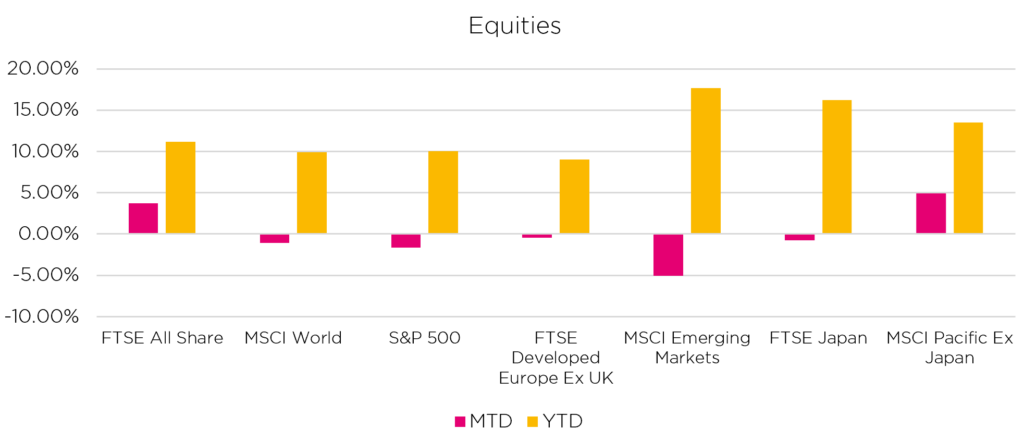
Global equities had a sharply bifurcated month, with a divergence between AI-linked and traditional sectors. The dominant story was a dramatic reversal in semiconductor and AI infrastructure names, driven by deepening investor concerns over the sustainability of Hyperscaler capital expenditure and linked chip-maker earnings. In South Korea, where memory chip manufacturers Samsung Electronics and SK Hynix dominate the KOSPI Index, the equity sell-off was acute. This led to emerging markets underperforming over the month.
Another significant story related to this reversal was that surrounding Situational Awareness LP, the AI-focused hedge fund run by 25-year-old former OpenAI researcher Leopold Aschenbrenner, which had grown to $45 billion in assets on the back of a more than 400% net return in the first half of 2026 alone. Concentrated long positions in AI infrastructure names combined with short positions in software stocks that moved sharply against the fund, together with reportedly running leveraged positions, triggered margin calls from prime brokers. The fund’s entire public equity book, roughly $16 billion, was sold to Ken Griffin’s Citadel in a single block trade in late July. The forced liquidation itself became a market event, with its removal as a seller contributing to a sharp rebound in the affected names. Against this backdrop, the S&P 500’s negative returns were offset by stronger results within healthcare and financials, with the latter demonstrating strong earnings particularly from trading desks.
In contrast, UK equities showed strong performance, with the FTSE 100 reaching record-breaking highs throughout the month, a slight improvement from its previous February peak. The index’s limited exposure to semiconductor and technology names proved a structural advantage in this environment, while heavy weightings in well-performing energy and financials acted as a tailwind. The FTSE 250 also participated to a lesser extent, with mining and industrial stocks contributing to strong FTSE All-Share performance.
Past performance is not necessarily a guide to future performance and is not guaranteed. Performance comparisons are included for illustration purposes only, there are no specific benchmarks.
Figure 1: Equity Market Returns (Source: Bloomberg, July 2026.)
Fixed Income
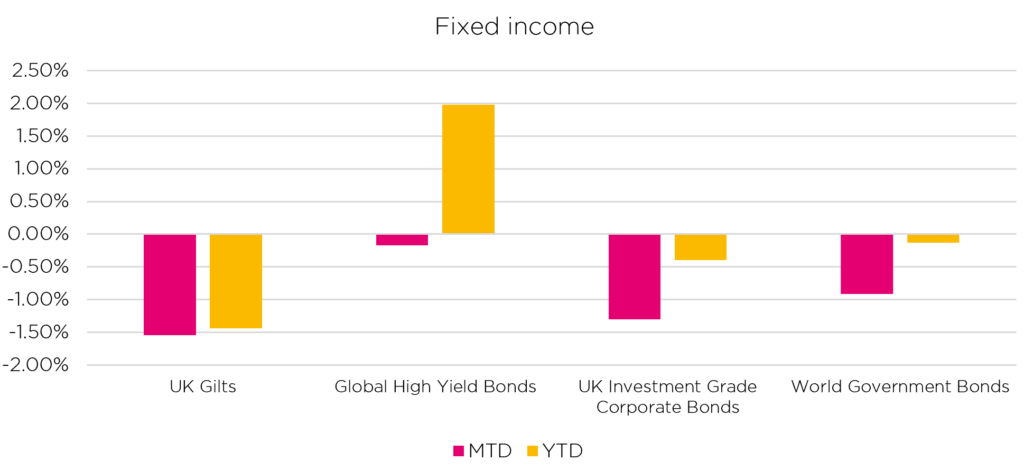
The July US Federal Reserve meeting was one of the more consequential of recent years, even though the Fed held rates steady in a 9-3 vote, with the three dissenters favouring an immediate hike, signalling the growing internal pressure to act. Chair Warsh’s decision to provide no forward guidance, reaffirming only the Fed’s unwavering commitment to its 2% inflation target, produced a sharp market reaction given the lack of action to achieve this. The 30-year Treasury yield surged to its highest level since 2007, marking a significant steepening of the US yield curve.
UK Gilts followed a similar trajectory, as the surge in oil prices over the month rekindled fears that the Middle East conflict could reignite domestic inflation and prompt further Bank of England tightening. The BoE voted 6-3 to hold rates unchanged at its July meeting, with three members favouring an immediate hike.
Corporate bonds came under pressure from two directions in July: rising underlying yields across the curve weighed on total returns, while spreads crept wider as concerns over AI-related debt issuance began to attract greater scrutiny. Hyperscalers have increasingly resorted to both equity and debt markets to finance capital expenditure programmes, while credit default swap pricing on several major technology names widened over the month, reflecting investor uncertainty over the pace and ultimate cost of AI infrastructure build-out. Investment-grade spreads, which had been historically tight coming into the month, widened somewhat but remained contained relative to historical norms.
Past performance is not necessarily a guide to future performance and is not guaranteed. Performance comparisons are included for illustration purposes only, there are no specific benchmarks.
Figure 2: Fixed income returns (Source: Bloomberg, July 2026)
Commodities
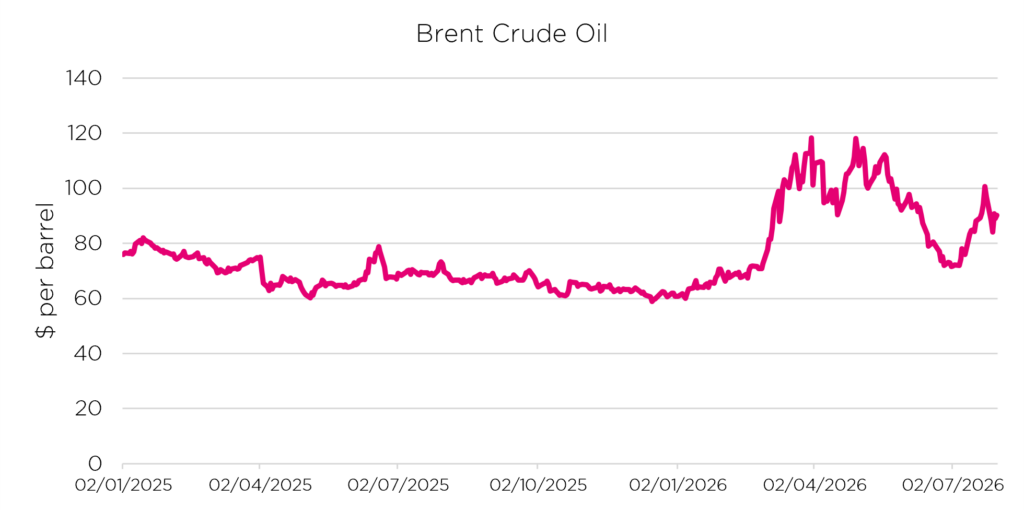
Oil reversed June’s sharp decline as hostilities between the US and Iran re-escalated through July, with Brent crude climbing back toward $90 a barrel, a reversal that amplified the inflation concerns that had been eased by the mid-June ceasefire. The re-pricing of energy risk fed directly into bond markets, contributing to the long-end yield spike following the FOMC meeting and provided a significant tailwind to energy-heavy equity markets, most visibly in the UK.
Past performance is not necessarily a guide to future performance and is not guaranteed. Performance comparisons are included for illustration purposes only, there are no specific benchmarks.
Figure 3: Brent Crude Oil price one-year changes (Source: Bloomberg, July 2026)
Summary
July highlighted a growing market unease about the assumptions that have underpinned the AI-driven rally of recent years. Questions around the scale, funding and ultimate returns of AI infrastructure investment reverberated across equity and credit markets, exposing crowded positioning and triggering episodes of forced deleveraging. At the same time, higher energy prices reintroduced inflation concerns, while the Federal Reserve’s lack of forward guidance, coupled with a strong commitment to the 2% inflation target despite taking no immediate policy action, unsettled investors and contributed to a sharp rise in long-dated yields. However, this is all set against a backdrop of supportive equity earnings and strong GDP growth. The result for the month was a broad repricing of risk, characterised by increased sector dispersion and renewed investor preference for businesses with resilient earnings and cash flows.